Story time: A Loggerhead’s Journey to Nest part 2

Thanks for tuning in as we continue on our mission as Panama City Beach Turtle Watch to protect sea turtles through our active volunteer program (full for this season) and through education efforts.

You’ll recall in our last post that our female loggerhead encountered bright lights and disturbance leading to a false crawl (non-nesting emergence). We now share the next chapter of her story.

Imagine you are the female loggerhead that very badly wants to nest. You are likely exhausted from your prior crawl where you attempted to nest but you instead escaped the paparazzi without nesting. You have returned to the water and begin to regain your strength and energy as you gracefully swim along. You have ~100 eggs that you are ready to lay but you need a good beach to lay them on. You swim, under the dark of night, about 3 miles from your first attempt. You pop your head up for a breath and see a darker empty beach, you are ready to give it another try. You swim toward the shoreline and emerge from the water. Once again crawling your ~300 pound self up the sandy beach about 60 feet and unfortunately something doesn’t feel right about this location. You wander a bit eastward, are you drawn to a bright light or the urban glow of Panama City? While your initial thought was this would make a good nesting site, you have now crawled over 130 feet from where you exited the water and haven’t nested, only to return to the water leaving another false crawl.

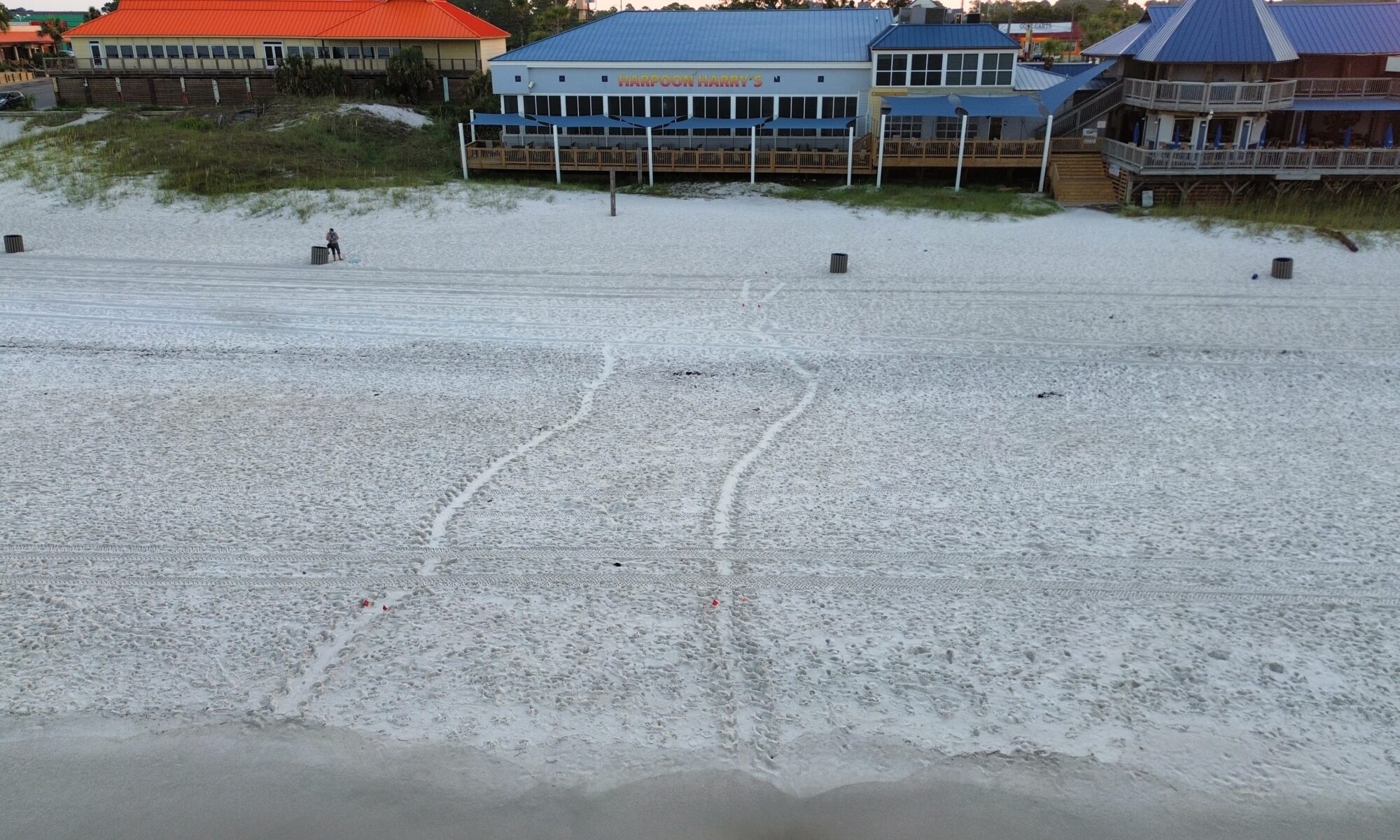
Above is the next crawl our surveyor found one recent morning. We have no beachgoer accounts of what happened at this location and based on the photos taken during our morning survey it doesn’t look like she was disturbed by beachgoers. But something wasn’t right, she wandered further than usual crawling over 130 feet parallel to the shore before returning to the water. On our Florida beaches, it is not uncommon to have false crawls as the turtles scope out the feel and appearance of the beach to choose their ideal nesting location. We assume this was a natural false crawl.

This particular loggerhead has now made two false crawls and is still very eager to nest. Where will she go next, stay tuned to find out!

If you encounter a sea turtle on our sandy beaches, please contact PCB non-emergency at 850-233-5000 and they will dispatch our volunteers. Please leave our beaches clean, dark and flat to provide the best nesting environment possible for these protected species!

False crawl #2 on a recent morning (believed to be the same turtle from a previous false crawl that morning based on the crawl width)
False crawl #2 on a recent morning, to the right in this picture is where she emerged from the water, made a turn and 130 feet later went back into the water without nesting. Notice the turtle tracks go over tire tracks, that is a sign to us that she was on the beach after other beach surveyors/officials/vendors were on the beach the previous day/night

Story time: A Loggerhead’s Journey to Nest

Join us for a multi-part story of a loggerhead’s attempt to nest on PCB to find out if she was successful.

Imagine you have been waiting all day knowing that tonight is the night to lay your eggs.  The sun has set and the beach appears darker.  You, the nesting loggerhead, choose a spot on PCB to exit the water, and crawl your ~300 pound self slowly about 80 feet onto the beach.  You begin digging your body pit and you are swarmed by the paparazzi.  Bright flashlights being shown on you, flash photos, a crowd getting a little too close for comfort and now you are temporarily blinded from all the bright lights.  You abort your digging and try to get away (but still can’t see clearly because of the bright lights) crawling another 25 feet toward the dune before figuring out the correct direction of the water.  The crowd is still very much nearby but you make a sharp turn and crawl over 100 foot back to the water to escape the paparazzi.  You made a good attempt but this wasn’t the time or place to nest.  Now it’s time to recover from that long exhausting and blinding crawl and decide where to next?

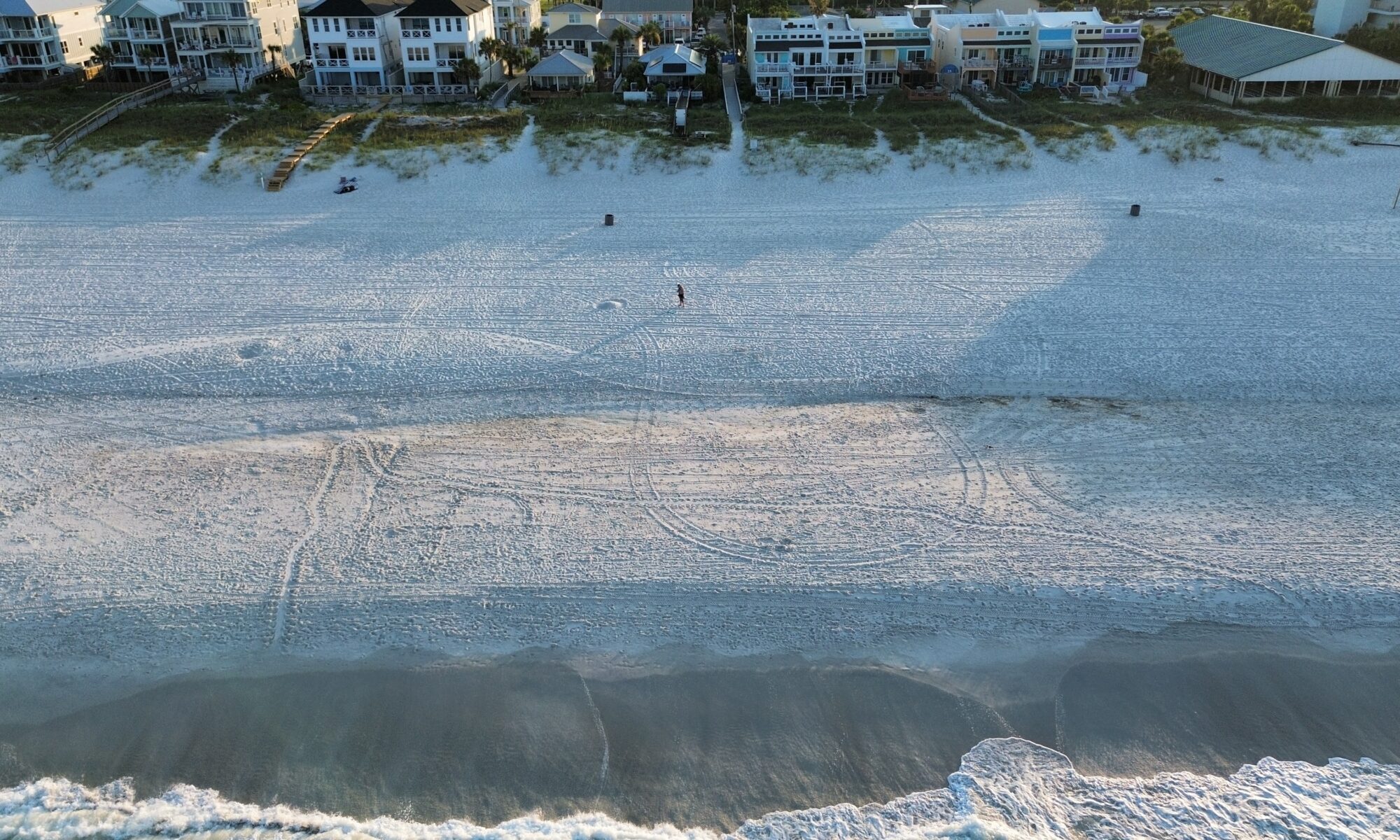
False Crawl (non-nesting emergence) by loggerhead sea turtle that was disturbed by beachgoers getting too close and using bright lights.
Birds eye view of the loggerhead false crawl as a result of disturbance by beachgoers using bright lights and getting too close

This is the scenario of a recent False Crawl shown in these photos.  It is evident by the photos as well as other beachgoer reports that this nesting loggerhead was disturbed enough that she was not able to nest at this location which is what is called a False Crawl (a non-nesting emergence).  Very near the trash can is where she finally turned and made her way back to the water.  Her crawl at that point was very hard to see in person given all of the footprints all around.

How could her experience have been a better one?  Beachgoers that encounter a nesting sea turtle (or hatchlings) should refrain from using any lights or flash photography. There is enough ambient light on our beaches that your eyes will adjust and you will be able to see what is happening without any additional light.  Stay behind the turtle, out of her line of sight, remain quiet and just observe nature.  As she moves, you should move too avoiding her crawl and staying behind her.  When you encounter a sea turtle on our sandy beaches, please contact PCB non-emergency at 850-233-5000 and they will dispatch our volunteers.  Please leave our beaches clean, dark and flat to provide the best nesting environment possible for these protected species!
Stay tuned in the coming days as we’ll share the next part of this nesting loggerhead’s journey.

Note: tire tracks near the water are from our morning surveyor that recorded data for this false crawl and then continued on with survey; other tire tracks are from law enforcement or vendors travelling the beach day and night and are the reasons that we respond asap to any report of a nesting turtle to get the area marked off for protection.  In this case, no nest was laid.

All work performed under MTP-038

Busy week with new nests and storm impacted nests

What a week our volunteers had!
They marked 6 loggerhead nests this week (we are at 23 nests so far as we approach the midpoint of our nest laying season).

In addition to volunteers responding to mark new nests found by surveyors this week, they responded to storm impacted nests which involved salvaging exposed eggs (sucked out by waves) and burying them at the dunes in a new marked nest as well as visiting several previously marked nests to bury stakes that had been washed away, as well as to install new stakes and caution tape at nests that have had so much sand accretion that the original stakes could barely be seen.

We are currently experiencing high tides that are impacting many of our nests.  When a nest receives too much water at once, it can stop the development of the eggs.  Since we don’t know how much is too much or what actually reaches those buried eggs, per the FWC permit we operate under we leave the nest marked for up to 80 days from when it was laid.  If a washed over nest doesn’t hatch (it usually takes 2 months) we’ll give it until day 80 just in case the incubation time was slowed down due to the water.  If it doesn’t hatch by then we’ll excavate it to determine the stage of development the eggs reached, which will likely coincide with this week’s high tide event.

This week we anticipate some additional impact to some of our nests as we continue to see tides/surge higher on the beach then it has been.  While this past week’s volunteers get some rest from all of their efforts, we have a new team ready to respond to any reports of nesting turtles, new nests or storm impacted nests.

All of our official volunteer spots are full and everyone has received FWC training.  But you can help us out….if you are on the beach and see a nesting turtle contact PCB Police non-emergency 850-233-5000 or if you see any storm impacted nests contact us via Facebook messenger.  This week we had several calls from beachgoers that provided us with reports that we were able to respond to quickly, we appreciate those reports!

All activities performed under MTP-038

Volunteers marking a newly laid nest. We fill out a form which includes a crawl diagram as the direction of the crawl and the turtle’s behavior that we can read from the sand gives us clues about where the nest may be located so we can protect it. We collect other pieces of data as well including species which can be determined by the crawl pattern.
An existing nest on the beach has received fresh wash over and sand has accreted therefore the original stakes are not effective for protecting the nest.
Viola, thanks to a new set of stakes and survey/caution tape, the area is successfully protected again. Thank you volunteers!

What to do if you see exposed eggs

In anticipation of high surf/surge this week we’d like to share some info that may be useful while you are visiting our beaches.

As per this year’s FWC permit guidelines, we leave nests in place when they are found and mark them for protection in their original location. That may put the nest at risk of wash-over or wash-out the two plus months it is incubating on the beach. If you see any exposed eggs (they look like ping pong balls) leave them where they are and contact us here on Facebook or via non-emergency PCB Police at 850-233-5000 and we’ll have our volunteers respond. Each nest is marked with a green tag that has the nest number, we’ll need that info and/or your location.

Our surveyors check the nests at least 4 times a day but having extra sets of eyes on our nests never hurts, so thank you for reporting any eggs you may see. But please, never replace any of the stakes or dig for the eggs, our volunteers will assess the situation and take care of it.

Sea turtles lay nests approximately every 2 weeks during the season. So while a couple of nests may be impacted, we’ll hope that the others are very successful!

Photo: Nest from a previous season that eroded and had exposed eggs

Work performed under MTP-038

Exposed eggs at a nest during a previous season

Volunteers busy all week, day and night!

Our surveyors and volunteers had a busy week.  We are currently at 17 marked nests, all loggerheads, and we have recorded 10 false crawls (turtle didn’t nest).

This week we had a variety of activity.  A couple times we had beach goers contact us through local police (or a Facebook message) when they saw a sea turtle on the beach.  This allowed our volunteers to respond asap.  Unfortunately, some of this week’s crawls turned into false crawls due to the turtle being disturbed/harassed.  Please remember these are a federal and state protected species. You need to keep it dark and give them space if you are on the beach with them.  The highlight of the week was some first year volunteers seeing a loggerhead finish covering her nest and return to the water, all thanks to some beach goers contacting our program asap.

While one group of volunteers was busy marking nests (day and night), we had another group of volunteers leading summer camp with PCB Parks and Recreation.  Campers learned about the different species of sea turtles and learned how to assess a stranded turtle to provide data to FWC as well as performing a necropsy!  

We appreciate all that our volunteers do, day or night, or both!
Please keep our beaches clean, dark and flat. Contact Panama City Beach non-emergency Police at 850-233-5000 if you see a sea turtle on the beach with no volunteers present.

A perfect loggerhead nest that was quickly marked thanks to a call to the police allowing our volunteers to respond asap. The track on the left side are the mother turtle’s tracks as she left the nest and returned to the water.

Loggerhead False Crawl, the track to the left is her return to the water, from her turn back to the water her track is covered in footprints, believed to be following the turtle too closely

Volunteers at the PCB Parks and Recreation Sea Turtle Camp, going through a mock stranding assessment

Volunteers at the PCB Parks and Recreation Sea Turtle Camp, going through a mock stranding assessment

What should you do if you see a sea turtle on our sandy beaches at night?

Nest 8 was found by surveyors this morning and it provides an opportunity to mention what you should do if you see a sea turtle on our sandy beaches at night.

Sea turtles often emerge overnight to nest so we often don’t get to see them.  They need no assistance, in fact we should give them a clean, dark, flat beach and observe from a distance. They will choose where to nest, dig the egg chamber, deposit eggs, cover them, and return to the water.  They can and should do this all unassisted.  

Here in PCB we are fortunate to have volunteers that have been trained by FWC on how to handle a nesting turtle encounter. If you happen to see a sea turtle on our sandy beaches at night, please call Panama City Beach police non-emergency at 850-233-5000 and they will contact our PCB Turtle Watch volunteers for immediate response.

Now, take a look at Nest 8 (a loggerhead) found this morning by surveyors.  Your eyes may be drawn to her nice looking track on the right where she emerged from the water and crawled onto the beach.  See the pretty pattern of a smoothed area with comma patterns (from her flippers) on either side, that is what we are looking for as a sign that a sea turtle has been on the beach. 

Nest 8

Now look in the newly marked off area, we normally find a large mound of fluffy sand where she covered up her nest with lots of thrown sand before turning to go back to the water.  Then on the left is her track back to the water.  Notice anything about the nest area and the left track compared to the right track?  If you guessed Footprints you are correct!  There are footprints all in the nest mound area (before it was marked for protection) and in her track back to the water indicating she was followed too closely.  

Visitors let us know this morning as we were marking the nest that they observed, from their balcony, the sea turtle late last night being ‘pushed back’ to the water.  This wasn’t necessary and likely added stress to the loggerhead.  Fortunately her eggs are buried in the sand so they should be ok for incubating over the next two months.   

So, if you do see a sea turtle on our sandy beaches at night, please call non-emergency police and our volunteers will respond to ensure the turtle has a safe environment during her nesting process.

With that said….we now have 8 nests marked for protection, all laid by loggerheads so far.

P.S. Never push any sea turtle or marine mammal back in the water.  Notify *FWC as local responders should visit the animal to assess the situation.

Three nests and two nesting turtle encounters!

What an exciting week for our volunteers!  Our nest count increased from 4 to 7 this week with all 3 nests being laid within an 8 hour period.  One evening this week, volunteers were called to a nesting loggerhead arriving in time to see her finish nesting and return to the water.  As they were marking nest 5, they received a report of another nesting loggerhead nearby.  They arrived in time to see her cover her nest and return to the water; they marked nest 6 for protection. A couple hours later, nest 7 was found during morning survey and marked for protection by the volunteers as well!  What an exciting couple of hours for this group of volunteers! These activities is what they prepared for and their quick response helped ensure the nesting turtles were not disturbed and that all nests are safely marked on our beach.

The two loggerheads observed by our volunteers had no identification tags.  Under our permit issued by FWC, one of our surveyors installed passive identification tags so that any other organization encountering the turtle can report their whereabouts. Maybe they will return to our beach or a nearby beach in a few weeks as they can lay a nest every couple of weeks of the season.  We hope to see them both again!

We are one month into our nesting season (we survey for new nests May through mid-September).  We have 7 nests marked for protection, all laid by loggerheads.  Per the FWC permit we operate under, we don’t announce the nest locations or predicted hatch dates. So stay tuned in a couple months to our Facebook page and we’ll announce excavations when we have a nest that has hatched.

What should you do if you encounter a sea turtle at night on the beach? Avoid using any lights, keep your distance, stay out of her line of sight and call local non-emergency local police at 850-233-5000 so they can contact our volunteers. Sea turtles can be very sensitive to light and sound. The nesting female had to work hard to crawl onto the beach to nest considering she was designed for the water, so let’s do our part to not disturb her!  

All activities conducted in accordance to MTP-24-038.

Loggerhead returning to the water after nesting

Nesting Volunteers are Ready!

Who’s on call? Our 2024 Nesting Volunteers!!!!

Our nesting volunteers completed FWC and local field training to prepare for our 2024 Nesting sea turtle season. They have been assigned scheduled dates in which they will respond to any nesting sea turtles or nests that may be located along our beach. They will mark the nest in a manner that it will remain protected as the eggs incubate for approximately 60 days.

We are grateful for the commitment by our volunteers as we work on our beaches to protect our local sea turtle population.

We are not permitted to release the location of nests or predicted hatch dates. When we have a public excavation following a hatch, that will be announced on our Facebook page.

We are no longer accepting any applications for our 2024 volunteer season, if you are interested next season reach out to us around February.

First nest of 2024 PCB TW Season!

We are excited to announce we have located and marked for protection our first 2024 sea turtle nest on Panama City Beach!

Overnight May 13th, a Loggerhead, came ashore and nested 🐢

Loggerheads are the most common nesting sea turtle on PCB but we have hopes of receiving Green and Leatherback nests this season as well! We’re open to a Kemp’s Ridley nesting as well which would be a first for our program.

What should you do if you encounter a sea turtle at night on the beach? Avoid using any lights, keep your distance, stay out of her line of sight and call local non-emergency police at 850-233-5000 so they can contact our volunteers. Sea turtles can be very sensitive to light and sound. The nesting female had to work hard to crawl onto the beach to nest considering she was designed for the water, so let’s do our part to not disturb her! Our surveyors begin patrol just before sunrise looking for sea turtle crawls so if you see a nesting turtle or a crawl, please avoid the area so we have the best look possible to assess the crawl when our surveyors or volunteers arrive.

Having located our first nest, we can now congratulate Melissa Taylor. Melissa submitted our 2024 First Nest Prediction form and she predicted our first nest very closely in all categories for date, time, species and location! Thanks to everyone that participated in that fun game!

Per the FWC permit we operate under, we don’t announce the nest locations or predicted hatch dates. So stay tuned during the season here for our nesting and hatching progress. Public excavation events will be posted on Facebook as they are scheduled following a hatch.

Check out this great informational poster about Loggerheads care of Sea Turtle Conservancy

Nest 1 of 2024 Season

All activities performed under MTP-038.

c/o Sea Turtle Conservancy

2024 Sea Turtle Nesting Season has begun!

The day our surveyors and volunteers have been waiting for has come….May 1st….the start of our 2024 sea turtle nesting season here in Panama City Beach!

Our surveyors headed out this morning just before sunrise as they will do daily between now and mid September looking for signs of sea turtle nests.

As we anxiously await finding our first nest of the season, we thought it would be fun to have our followers predict the details of our first nest of the 2024 Season.

Use this form to submit your PCB TW first nest of 2024 Prediction! The winner will be selected from form submissions and will receive their choice of a PCB Turtle Watch merchandise item!

Stay tuned here or on Facebook for updates throughout the season🐢

Surveyors
Morning surveyors begin 2024 Sea Turtle Nesting patrol