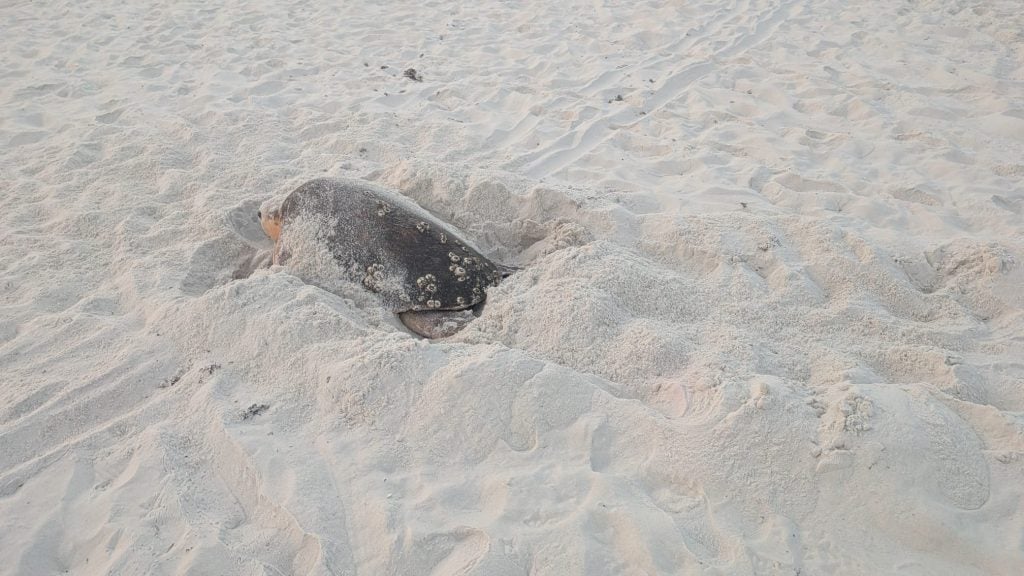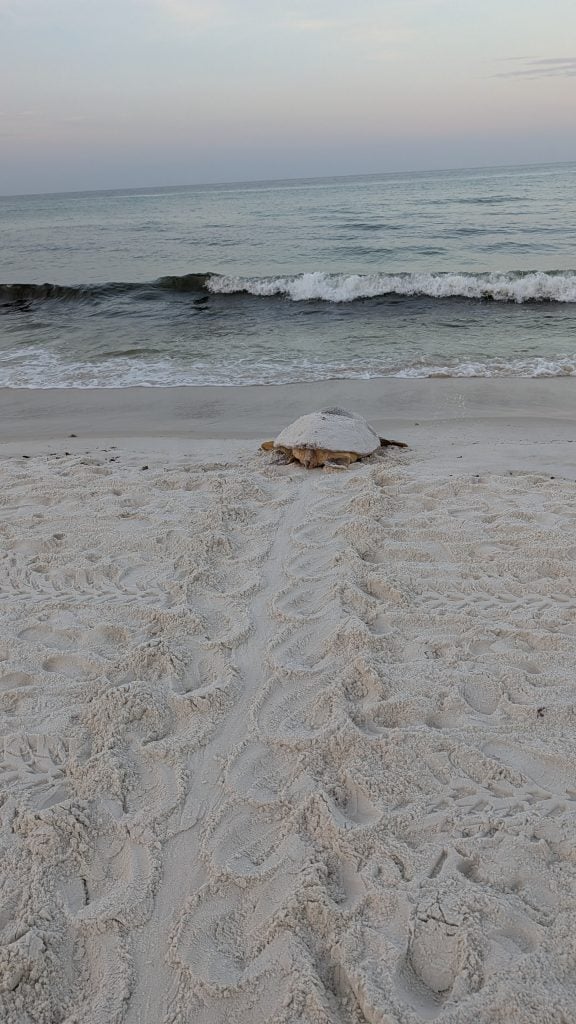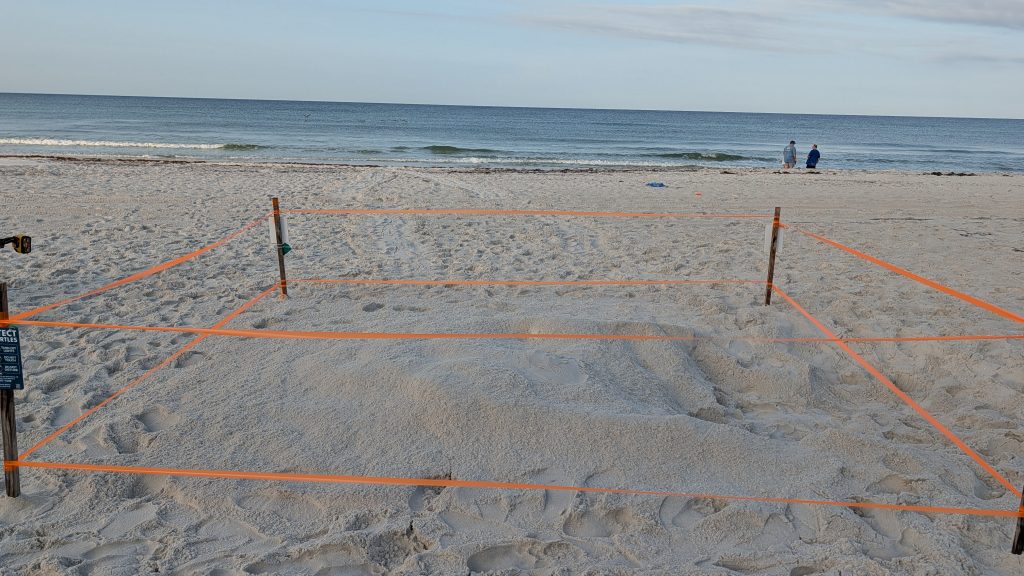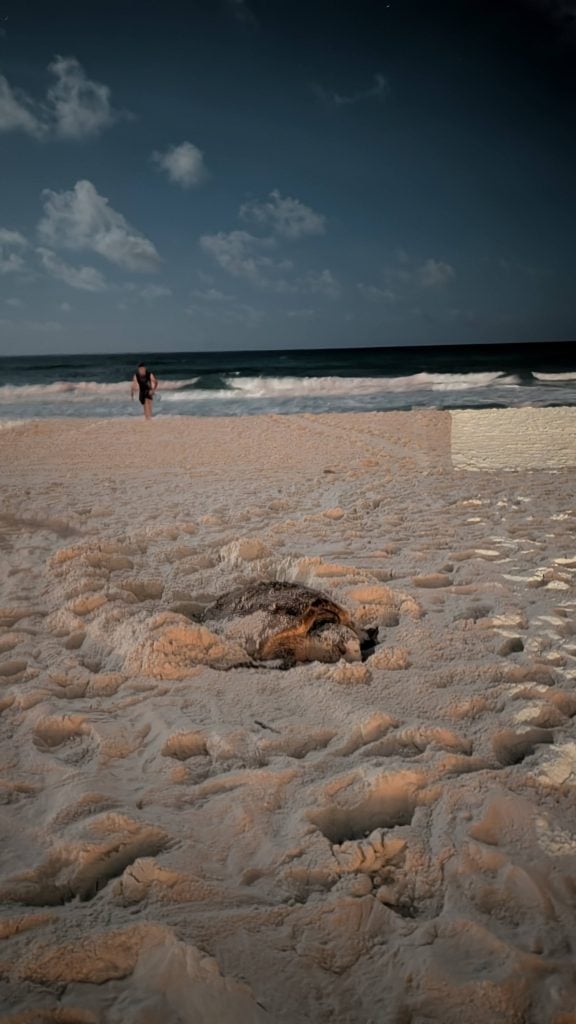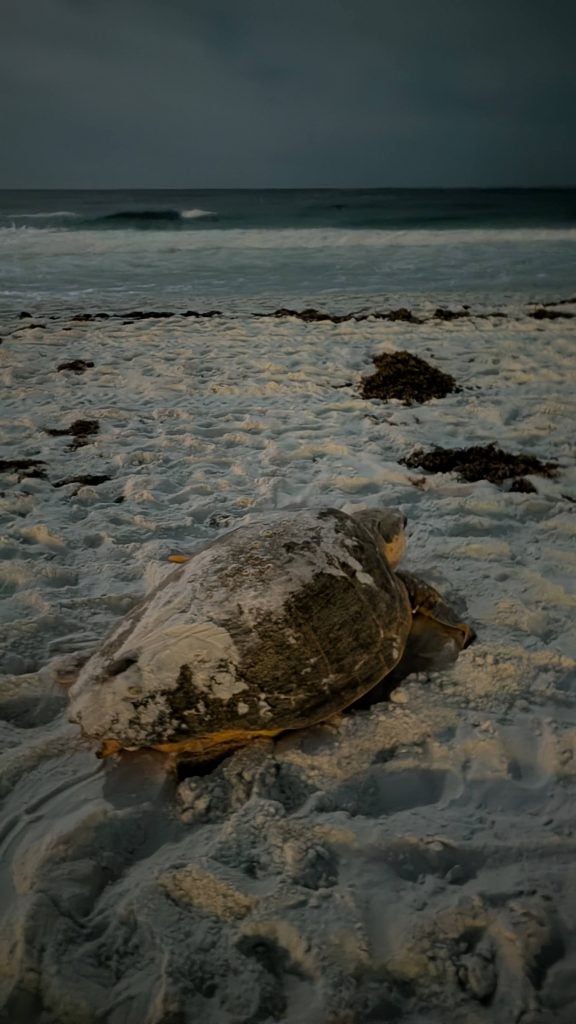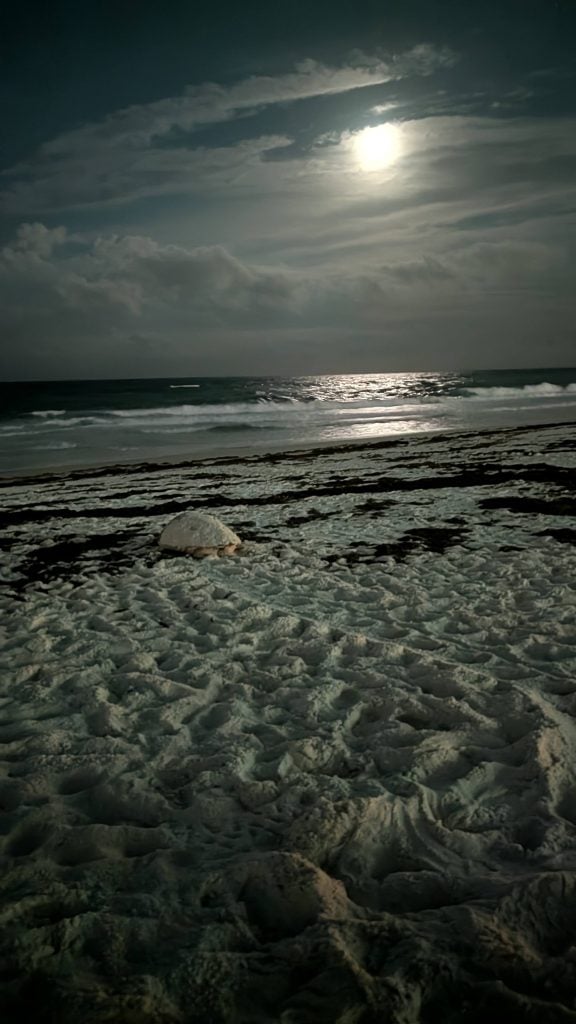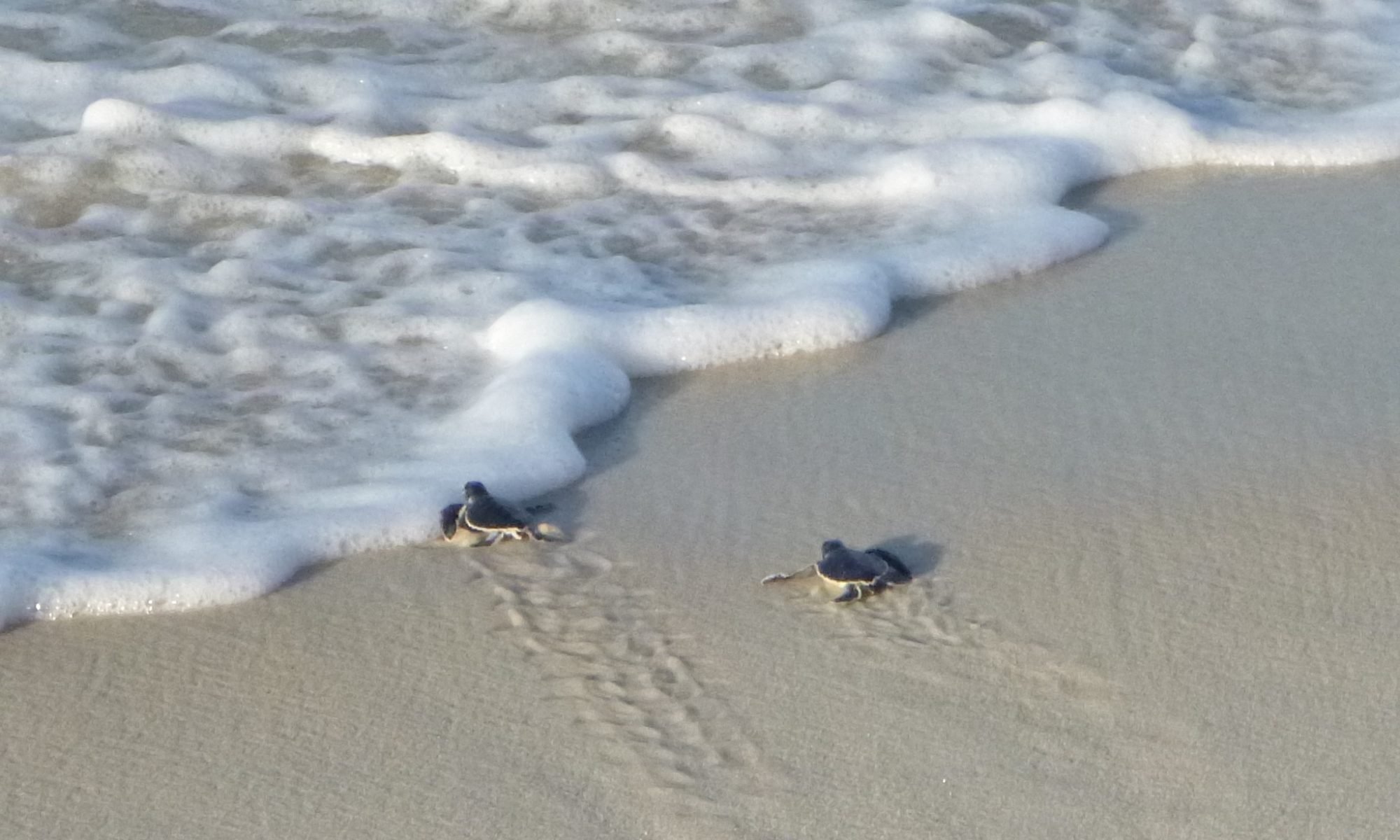
This morning, our ATV surveyor encountered a nesting loggerhead here on Panama City Beach. She finished her nesting process, turned and made it back to the water. Volunteers responded and marked the nest area for protection. It takes about 2 months on our beach for the eggs (on average 100 eggs buried 10-20 inches deep) to incubate and hatch. It’s uncommon for us to witness and video a nesting female on shore since it commonly happens overnight. If you encounter a sea turtle on the beach, remember to refrain from using any lights or flash photos and stay behind her observing from a distance and call Beach Police non-emergency 850-233-5000 with the location and our volunteers will respond.
We were able to get a couple of quick videos as she was about to reach the water after nesting.
Loggerhead during her nesting process (photo by permitted surveyor of MTP-038) Loggerhead returns to the water after nesting at sunrise
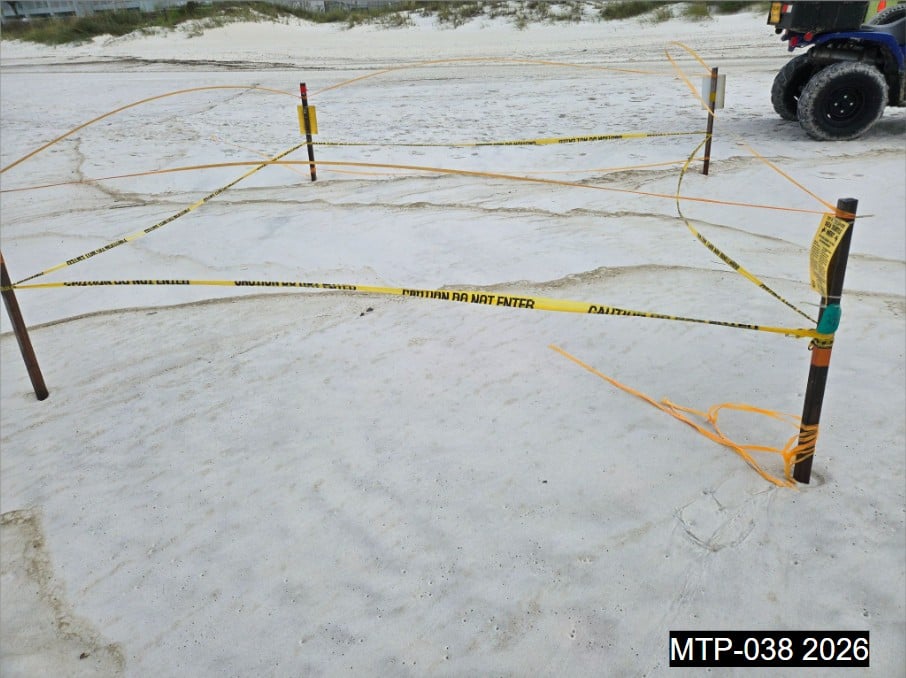
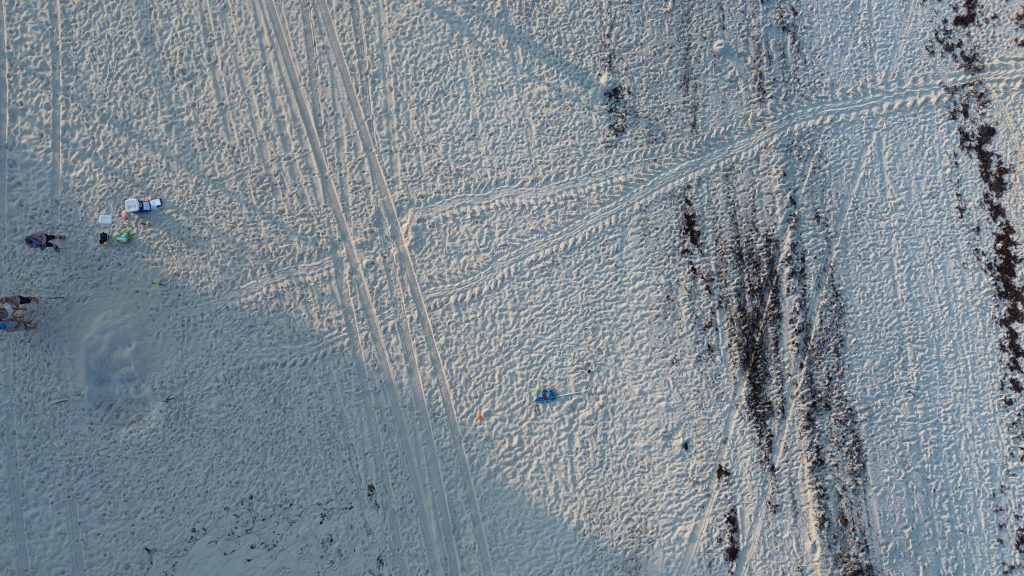
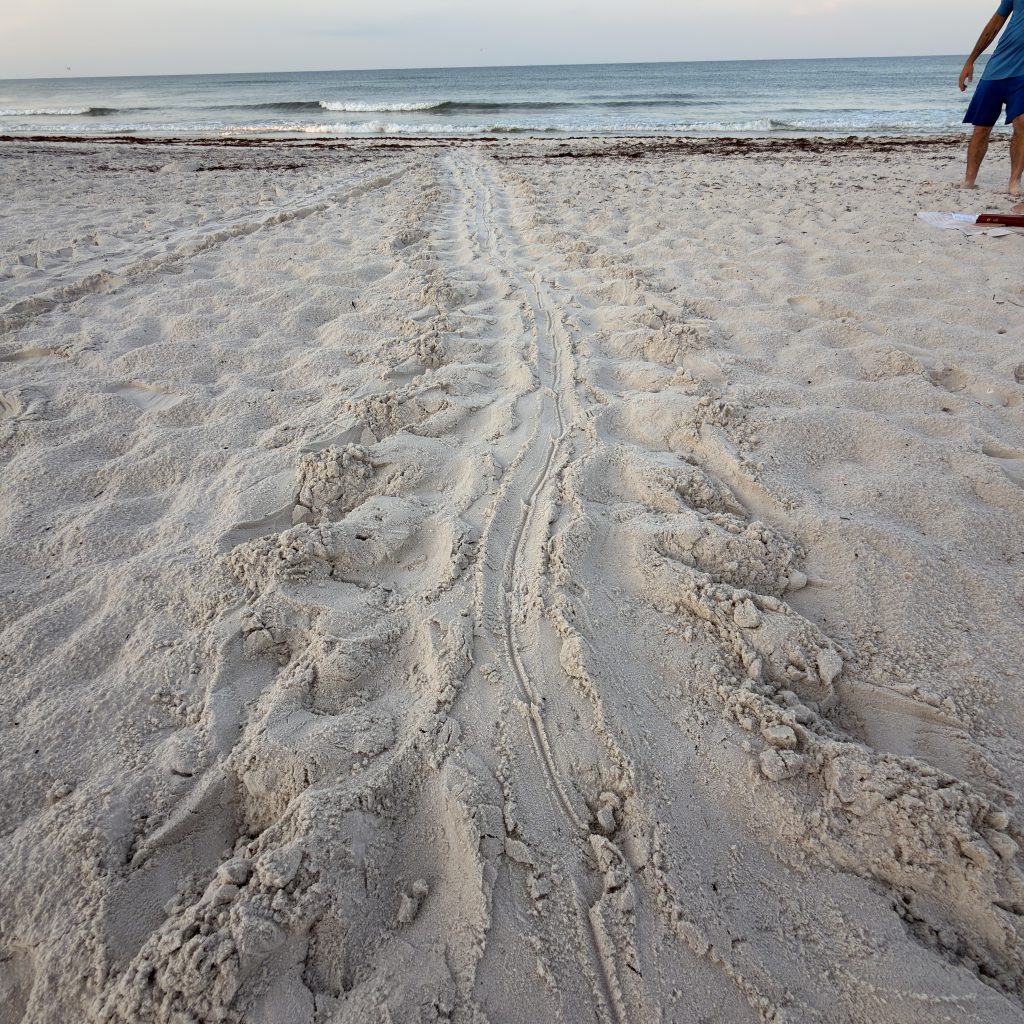
Let’s test out your sea turtle knowledge. Do you know what species of turtle left this nest on PCB? Aerial view of a crawl and nest Fresh nest marked for protection Path back to the water after nesting
If you guessed loggerhead, that is a reasonable guess considering that is the most common species (1013 loggerhead nests since 1991 – current) here on our beach.
If you guessed leatherback, that is not a bad guess without size reference in the photos. They are the largest species leaving a track up to 7 foot wide. We haven’t had a leatherback nest on our beach since 2019 (14 total since 1991) but are hoping we’ll see some in the future years.
Those that guessed this is a green sea turtle crawl and nest are correct. To date since 1991, we have marked 40 green nests for protection here on PCB.
Some of the common characteristics of a green crawl/nest:
– flippers observed on the crawl are parallel as they propel themselves forward with both sides of flippers at the same time
– high on the beach or to the dunes
– a noticeable tail drag (the line down the center of the crawl)
– a deep body pit before she digs the chamber (this makes the eggs deeper), sometimes from a distance you can’t even see her on the beach she has dug so deep
– a large mound with a lot of thrown sand covering/disguising her nest
Last night, our Panama City Beach Turtle Watch volunteers had an incredible experience responding to a nesting turtle reportâand we have an amazing story to share!
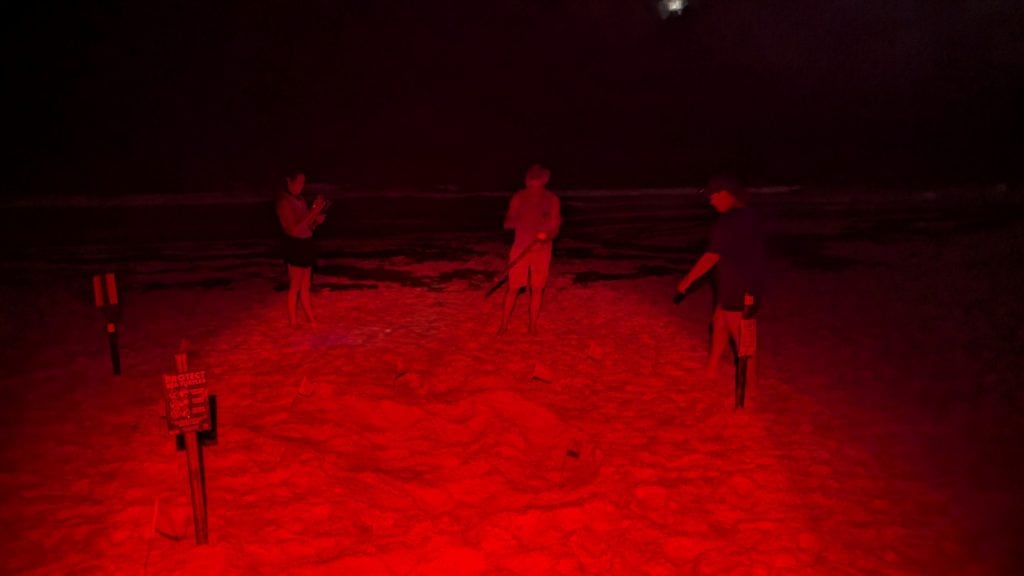
When our team arrived, they found awesome beachgoers observing the turtle from a respectful distance in total darkness (no flashlights or flash photography). Because of their cooperation, our volunteers were able to safely assess the turtle and scan her for tags.
đ An Unexpected History
We discovered she had a passive tag (similar to a pet microchip). She wasnât a turtle we had tagged on PCB before, so we consulted other organizations to try to find her history. It turns out she was originally tagged in June 2018 on Cape San Blas, and nested again that same month at St. Joseph Peninsula State Park (other Panhandle beaches to our east).
Eight years later, she chose PCB to lay her most recent clutch. This is our fourth turtle encounter this season as part of our tagging research permit. The first one that already had a tag while the other three had new tags installed. It’s a beautiful reminder of how many organizations are doing their best to study sea turtle behaviors and protect these federally and state protected species.
â Frequently Asked Questions From the Beach
Here are some of the top questions our volunteers answered last night:
– How old is she? Loggerheads reach maturity around 25 years. Because we know she was already nesting in 2018, this mama is at least 36 years old!
– Will she come back to check on her nest? No. She covers her eggs, returns to the Gulf, and her job is done. However, she may nest again on a Panhandle beach as sea turtles can lay eggs roughly every 2 weeks during the season.
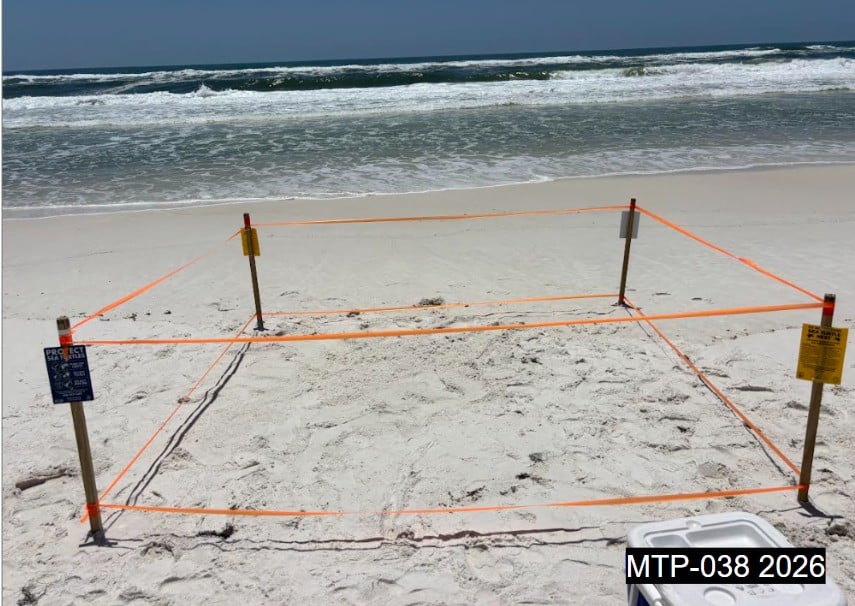
– How do you find nests if no one sees the turtle? Every morning from May 1 to September 15, our dedicated surveyors patrol the waterline at dawn looking for sea turtle “crawls” (tracks). If the track characteristics confirm a nest, our volunteers mark it for protection (4 wooden stakes with signage and survey/caution tape).
– What species is it? We identify the turtles based on their appearance or the track they leave; in this case she is a loggerhead, the most common nesting species on our beach.
– Why use red flashlights? White lights and camera flashes easily disorient or scare sea turtles. Red light is much more wildlife-friendly and preserves human night vision. We use it as sparingly as possible and encourage other beachgoers to do the same.
– How many eggs are in there and when will they hatch? Nests average about 100 ping-pong-ball-sized eggs and incubate for roughly two months on our beach. We won’t know the exact count until we excavate the nest 3 to 4 days after it hatches.
– Can we watch the nest hatch? We do not announce predicted hatch dates or specific locations. If you happen to witness a natural hatch at night, keep all lights off, give them space, and let them crawl to the water. If they seem disoriented, call the number on the blue sign at the nest immediately and our volunteers will respond.
– How can we find the results of this specific nest? Take note of the number on the green tag of the nest stakes. If it’s in an accessible area, we will post a public excavation date under our Facebook “Events” section to take place 3â4 days after it hatches, or we’ll share the final inventory results right here online.
đ How You Can Help!
If you encounter a sea turtle on the beach at night, please:
– Keep it dark: Turn off all lights and phone flashes.
– Give her space: Stay at a distance and remain behind her line of sight.
– Hands off: Avoid her tracks and the disturbed sand.
– Call it in: Immediately contact the PCB Police (Non-Emergency) at 850-233-5000. They will dispatch our on-call volunteers immediately!
Thank you to last night’s beachgoers for setting a perfect example. We can all follow their lead and keep our beaches clean, dark, and flat!
Photos taken with no flash (cell phone night sight mode was used) under MTP-038Nesting loggerhead (no flash used, cell phone night sight mode used) MTP-038 Loggerhead returning to the water after nesting (no flash used, cell phone night sight mode used) MTP-038 A loggerhead returns to the Gulf after nesting (no flash used, cell phone night sight mode used) MTP-038 MTP-038 volunteers marking a loggerhead nest for protection after she has returned to the water
đ˘ NEST UPDATE: The Good News, the Bad News, and How You Can Help! đ
First, the good news: We currently have 22 loggerhead nests marked for protection across Panama City Beach! đ
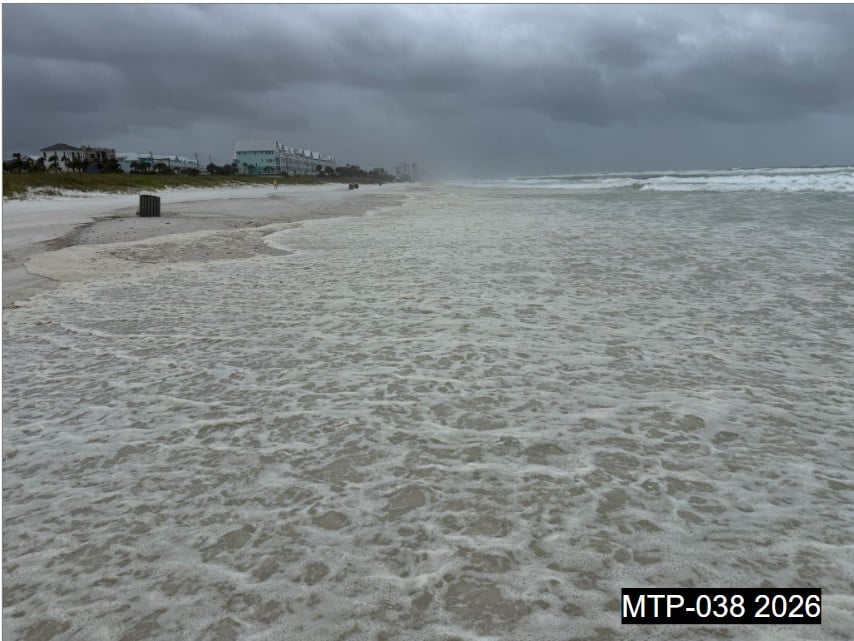
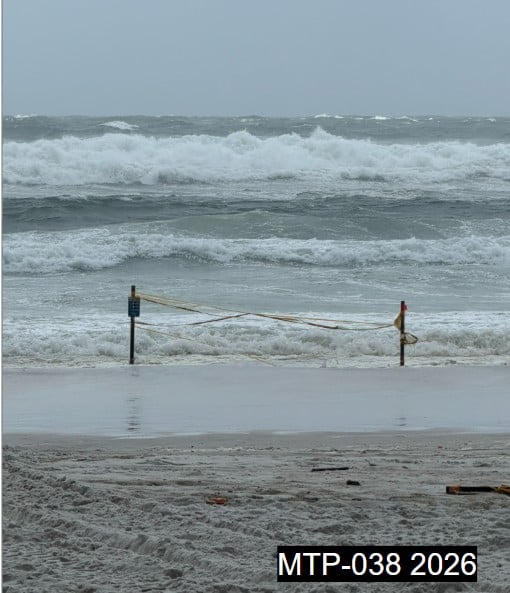
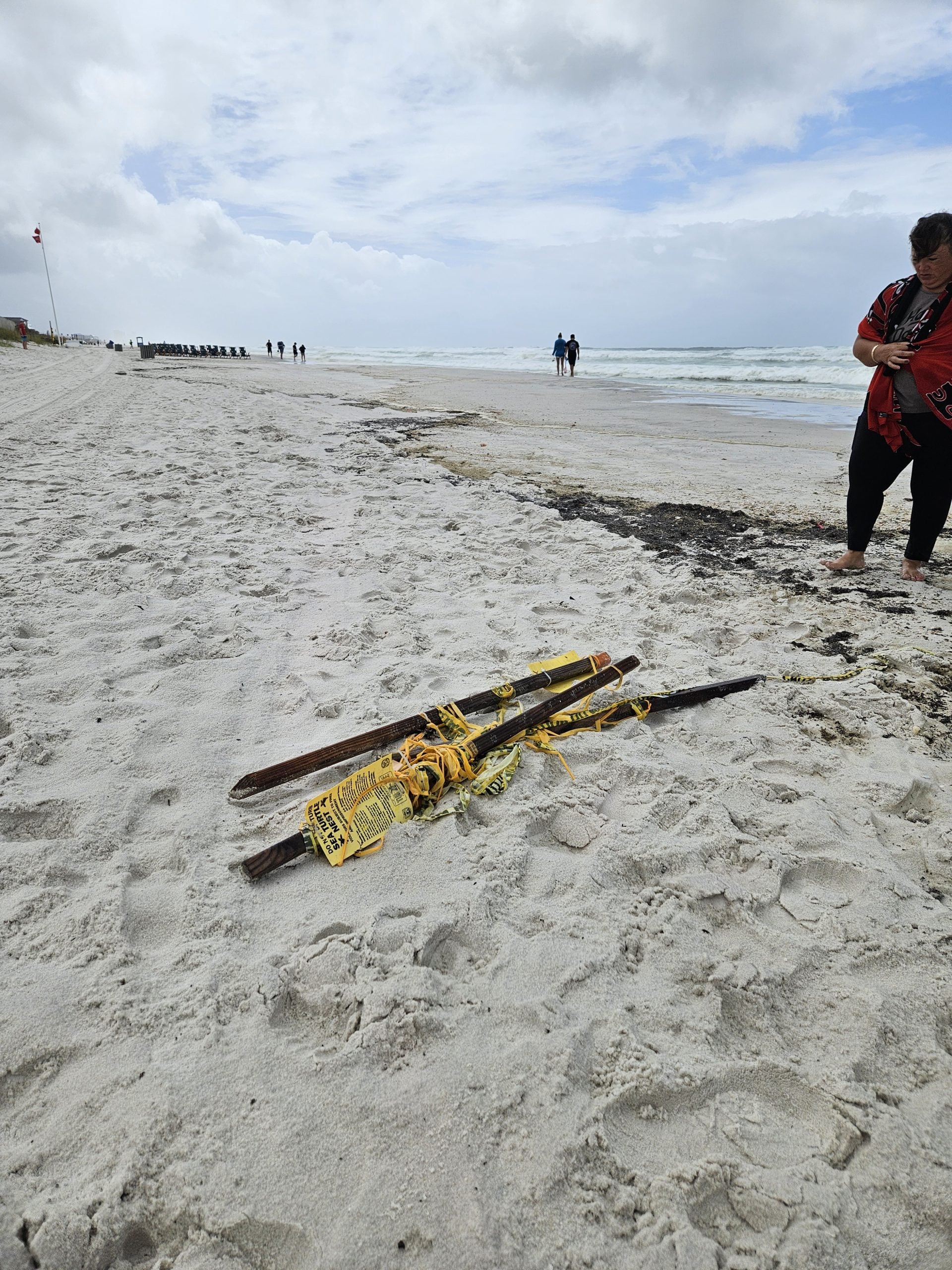
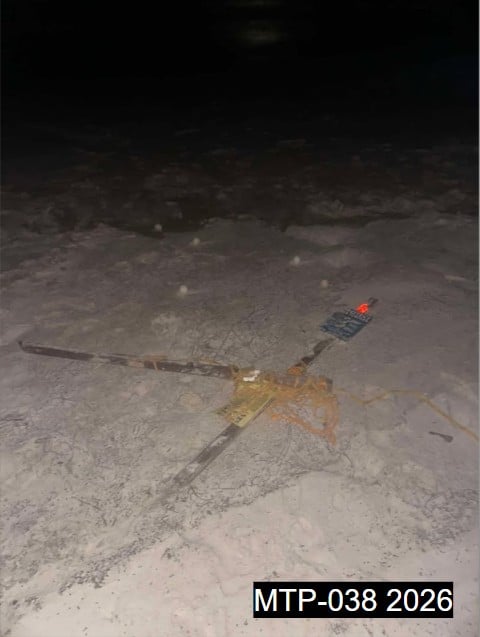
Now for the bad news: We are currently experiencing very high tides, drastic daily changes in beach depth, and strong surf. This rough weather is impacting some of our nests with waves wash over them or even washing them out.
Why can’t we just move them?
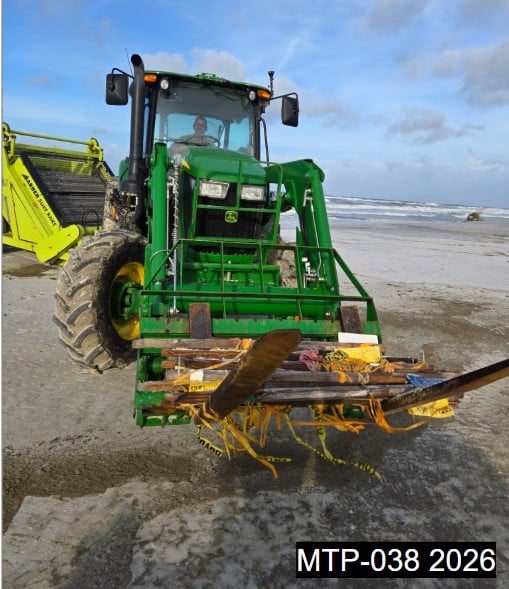
We operate under an FWC permit that requires us to leave nests in place once they are marked. Even if a nest is getting washed over by waves or the stakes are washed out, we are not permitted to relocate it unless we encounter exposed eggs (which are the size and shape of a ping-pong ball). Otherwise, our rule is to leave them in place and monitor them daily.
How you can help :
Our surveyors check the nests at least 4 times a day, but extra eyes always help! If you see downed stakes or exposed eggs:
đŤ DO NOT replace the stakes or dig for the eggs yourself.
đ DO note your specific street address or beach location and where the eggs are on the beach (close to the water, at the wrack line).
đ DO report it immediately via Facebook message, the phone number on the blue sign at the nest, or the non-emergency PCB Police line at 850-233-5000.
Looking Ahead:
Sea turtles lay nests approximately every two weeks during the season, and we are still in the first half of our nesting season! While some of our current nests may be impacted, we remain optimistic for the rest of the season. đ¤đ˘
Work performed under MTP-038
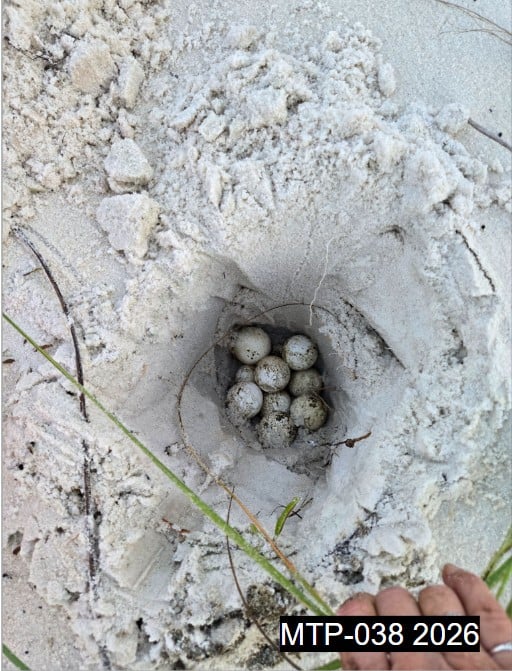
đ¸ Photo: A nest from a previous season that eroded and had exposed eggs.
In anticipation of high surf/surge this week we’d like to share some info that may be useful while you are visiting our beaches.
As per this year’s FWC permit guidelines, we leave nests in place when they are found and mark them for protection in their original location. That may put the nest at risk of wash-over or wash-out the two plus months it is incubating on the beach. If you see any exposed eggs (they look like ping pong balls) leave them where they are and contact us here on Facebook or via non-emergency PCB Police at 850-233-5000 and we’ll have our volunteers respond. Each nest is marked with a green tag that has the nest number, we’ll need that info and/or your location.
Our surveyors check the nests at least 4 times a day but having extra sets of eyes on our nests never hurts, so thank you for reporting any eggs you may see. But please, never replace any of the stakes or dig for the eggs, our volunteers will assess the situation and take care of it.
Sea turtles lay nests approximately every 2 weeks during the season. So while a couple of nests may be impacted, we’ll hope that the others are very successful!
Photo: Nest from a previous season that eroded and had exposed eggs
Work performed under MTP-038Exposed eggs at a nest during a previous season
Our surveyors and volunteers had a busy week. We are currently at 17 marked nests, all loggerheads, and we have recorded 10 false crawls (turtle didn’t nest).
This week we had a variety of activity. A couple times we had beach goers contact us through local police (or a Facebook message) when they saw a sea turtle on the beach. This allowed our volunteers to respond asap. Unfortunately, some of this week’s crawls turned into false crawls due to the turtle being disturbed/harassed. Please remember these are a federal and state protected species. You need to keep it dark and give them space if you are on the beach with them. The highlight of the week was some first year volunteers seeing a loggerhead finish covering her nest and return to the water, all thanks to some beach goers contacting our program asap.
While one group of volunteers was busy marking nests (day and night), we had another group of volunteers leading summer camp with PCB Parks and Recreation. Campers learned about the different species of sea turtles and learned how to assess a stranded turtle to provide data to FWC as well as performing a necropsy! Â
We appreciate all that our volunteers do, day or night, or both!
Please keep our beaches clean, dark and flat. Contact Panama City Beach non-emergency Police at 850-233-5000 if you see a sea turtle on the beach with no volunteers present. A perfect loggerhead nest that was quickly marked thanks to a call to the police allowing our volunteers to respond asap. The track on the left side are the mother turtle’s tracks as she left the nest and returned to the water.
Loggerhead False Crawl, the track to the left is her return to the water, from her turn back to the water her track is covered in footprints, believed to be following the turtle too closely
Volunteers at the PCB Parks and Recreation Sea Turtle Camp, going through a mock stranding assessment Volunteers at the PCB Parks and Recreation Sea Turtle Camp, going through a mock stranding assessment
Nest 8 was found by surveyors this morning and it provides an opportunity to mention what you should do if you see a sea turtle on our sandy beaches at night.
Sea turtles often emerge overnight to nest so we often don’t get to see them. They need no assistance, in fact we should give them a clean, dark, flat beach and observe from a distance. They will choose where to nest, dig the egg chamber, deposit eggs, cover them, and return to the water. They can and should do this all unassisted. Â
Here in PCB we are fortunate to have volunteers that have been trained by FWC on how to handle a nesting turtle encounter. If you happen to see a sea turtle on our sandy beaches at night, please call Panama City Beach police non-emergency at 850-233-5000 and they will contact our PCB Turtle Watch volunteers for immediate response.
Now, take a look at Nest 8 (a loggerhead) found this morning by surveyors. Your eyes may be drawn to her nice looking track on the right where she emerged from the water and crawled onto the beach. See the pretty pattern of a smoothed area with comma patterns (from her flippers) on either side, that is what we are looking for as a sign that a sea turtle has been on the beach.Â
Nest 8
Now look in the newly marked off area, we normally find a large mound of fluffy sand where she covered up her nest with lots of thrown sand before turning to go back to the water. Then on the left is her track back to the water. Notice anything about the nest area and the left track compared to the right track? If you guessed Footprints you are correct! There are footprints all in the nest mound area (before it was marked for protection) and in her track back to the water indicating she was followed too closely. Â
Visitors let us know this morning as we were marking the nest that they observed, from their balcony, the sea turtle late last night being ‘pushed back’ to the water. This wasn’t necessary and likely added stress to the loggerhead. Fortunately her eggs are buried in the sand so they should be ok for incubating over the next two months. Â
So, if you do see a sea turtle on our sandy beaches at night, please call non-emergency police and our volunteers will respond to ensure the turtle has a safe environment during her nesting process.
With that said….we now have 8 nests marked for protection, all laid by loggerheads so far.
P.S. Never push any sea turtle or marine mammal back in the water. Notify *FWC as local responders should visit the animal to assess the situation.
What an exciting week for our volunteers! Our nest count increased from 4 to 7 this week with all 3 nests being laid within an 8 hour period. One evening this week, volunteers were called to a nesting loggerhead arriving in time to see her finish nesting and return to the water. As they were marking nest 5, they received a report of another nesting loggerhead nearby. They arrived in time to see her cover her nest and return to the water; they marked nest 6 for protection. A couple hours later, nest 7 was found during morning survey and marked for protection by the volunteers as well! What an exciting couple of hours for this group of volunteers! These activities is what they prepared for and their quick response helped ensure the nesting turtles were not disturbed and that all nests are safely marked on our beach.
The two loggerheads observed by our volunteers had no identification tags. Under our permit issued by FWC, one of our surveyors installed passive identification tags so that any other organization encountering the turtle can report their whereabouts. Maybe they will return to our beach or a nearby beach in a few weeks as they can lay a nest every couple of weeks of the season. We hope to see them both again!
We are one month into our nesting season (we survey for new nests May through mid-September). We have 7 nests marked for protection, all laid by loggerheads.  Per the FWC permit we operate under, we don’t announce the nest locations or predicted hatch dates. So stay tuned in a couple months to our Facebook page and we’ll announce excavations when we have a nest that has hatched.
What should you do if you encounter a sea turtle at night on the beach? Avoid using any lights, keep your distance, stay out of her line of sight and call local non-emergency local police at 850-233-5000 so they can contact our volunteers. Sea turtles can be very sensitive to light and sound. The nesting female had to work hard to crawl onto the beach to nest considering she was designed for the water, so let’s do our part to not disturb her! Â
All activities conducted in accordance to MTP-24-038. Loggerhead returning to the water after nesting
Our nesting volunteers completed FWC and local field training to prepare for our 2024 Nesting sea turtle season. They have been assigned scheduled dates in which they will respond to any nesting sea turtles or nests that may be located along our beach. They will mark the nest in a manner that it will remain protected as the eggs incubate for approximately 60 days.
We are grateful for the commitment by our volunteers as we work on our beaches to protect our local sea turtle population.
We are not permitted to release the location of nests or predicted hatch dates. When we have a public excavation following a hatch, that will be announced on our Facebook page.
We are no longer accepting any applications for our 2024 volunteer season, if you are interested next season reach out to us around February.
We are excited to announce we have located and marked for protection our first 2024 sea turtle nest on Panama City Beach!
Overnight May 13th, a Loggerhead, came ashore and nested đ˘
Loggerheads are the most common nesting sea turtle on PCB but we have hopes of receiving Green and Leatherback nests this season as well! We’re open to a Kemp’s Ridley nesting as well which would be a first for our program.
What should you do if you encounter a sea turtle at night on the beach? Avoid using any lights, keep your distance, stay out of her line of sight and call local non-emergency police at 850-233-5000 so they can contact our volunteers. Sea turtles can be very sensitive to light and sound. The nesting female had to work hard to crawl onto the beach to nest considering she was designed for the water, so let’s do our part to not disturb her! Our surveyors begin patrol just before sunrise looking for sea turtle crawls so if you see a nesting turtle or a crawl, please avoid the area so we have the best look possible to assess the crawl when our surveyors or volunteers arrive.
Having located our first nest, we can now congratulate Melissa Taylor. Melissa submitted our 2024 First Nest Prediction form and she predicted our first nest very closely in all categories for date, time, species and location! Thanks to everyone that participated in that fun game!
Per the FWC permit we operate under, we don’t announce the nest locations or predicted hatch dates. So stay tuned during the season here for our nesting and hatching progress. Public excavation events will be posted on Facebook as they are scheduled following a hatch.
Check out this great informational poster about Loggerheads care of Sea Turtle ConservancyNest 1 of 2024 Season