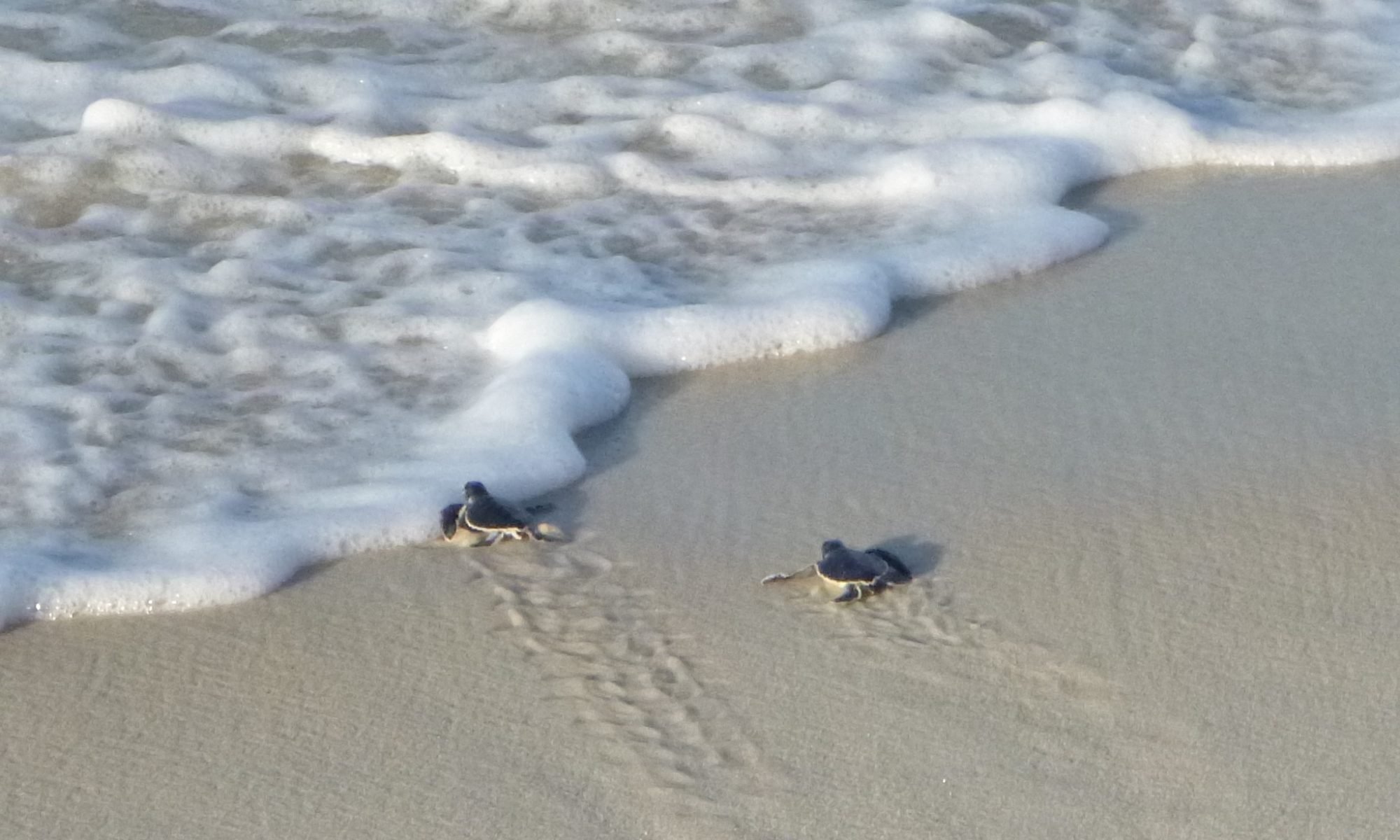
We were honored to participate in the Science and Discovery Center’s Pirates and Mermaids camp this past week. Our volunteers shared information about our program and then allowed the campers to see some of the specimens up close. Young minds are like sponges and the campers were attentive and had the opportunity to learn about Sea Turtles and ways we can all help protect them.


Lifetime Achievement Volunteer Awards
Now that our 2024 hatching has started we would like to recognize two of our volunteers heavily involved in our hatching activities.
At the beginning of this season Nancy Evou and Betsy Straley were both recognized by Panama City Beach Turtle Watch with Lifetime Achievement awards recognizing their long running contributions to our program. To relate their years of service to sea turtles, the hatchlings that they helped in their first year could very well be returning to our beaches now or in a few years to lay their own nests!
Our program has been in place since 1991 and let’s just say these two volunteers have done it all! They have contributed countless hours each year and we hope they are able to continue for many more!
In her recent volunteer years, Betsy is out on the beach at night as part of the hatching monitoring team. She also helps with our education outreach initiatives and strandings (sick, injured or deceased sea turtles).
Nancy is involved in just about every aspect of PCB TW. Her volunteer efforts are most often seen through the education outreach, strandings and very much so all of the nest excavations!
We are very appreciative of all of the efforts and hours that Nancy and Betsy give to our program and look forward to having them on our team for many years ahead!

Hatching season kicks off this week!
It’s a date our volunteers have been waiting for….it’s been 2 months since the first nest of the season was laid on PCB and that means we should be entering our hatching season any night now!
Here on Panama City Beach, we have a high level of hatchling disorientation with hatchlings going towards artificial lighting instead of the shimmering Gulf of Mexico. Our volunteers received training from FWC and our local program to aid or rescue hatchlings if they are disoriented. No one other than permitted volunteers can handle hatchlings but there are ways that anyone along our 18 miles of beach can help protect hatchlings. Please help us reduce artificial lighting on the beach, especially if you have noticed a marked nest in the area. Clean, dark and flat is the best environment for hatchlings.
Clean: Leave No Trace, remove all of your belongings and trash from the beach each night
Dark: Keep exterior beach visible lights off and blinds/curtains drawn to reduce interior light visibility, reduce flashlight usage and use red LED flashlights if needed
Flat: Fill in holes and knock down sand castles (this prevents sea turtles from wasting energy struggling as the cross the sand)
Please refrain from touching any hatchlings and do not disturb their nest area. We know that we have many visitors on the beach so we have various signs, as shown in these photos, to try to share these messages so we can all do our part to help protect the sea turtles on our beaches.
We don’t announce nest locations or predicted hatch dates. What we will announce is an excavation which will take place 3-4 days after a hatch (we don’t know any further in advance than that). Where possible, we’ll invite the public to attend the excavation and we’ll also attempt to go live on Facebook for those unable to attend in person.
Thank you in advance to our hatching volunteers for the many hours they are about to spend between now and late October helping to protect the hatchlings on PCB!


Story time: A Loggerhead’s Journey to Nest Conclusion
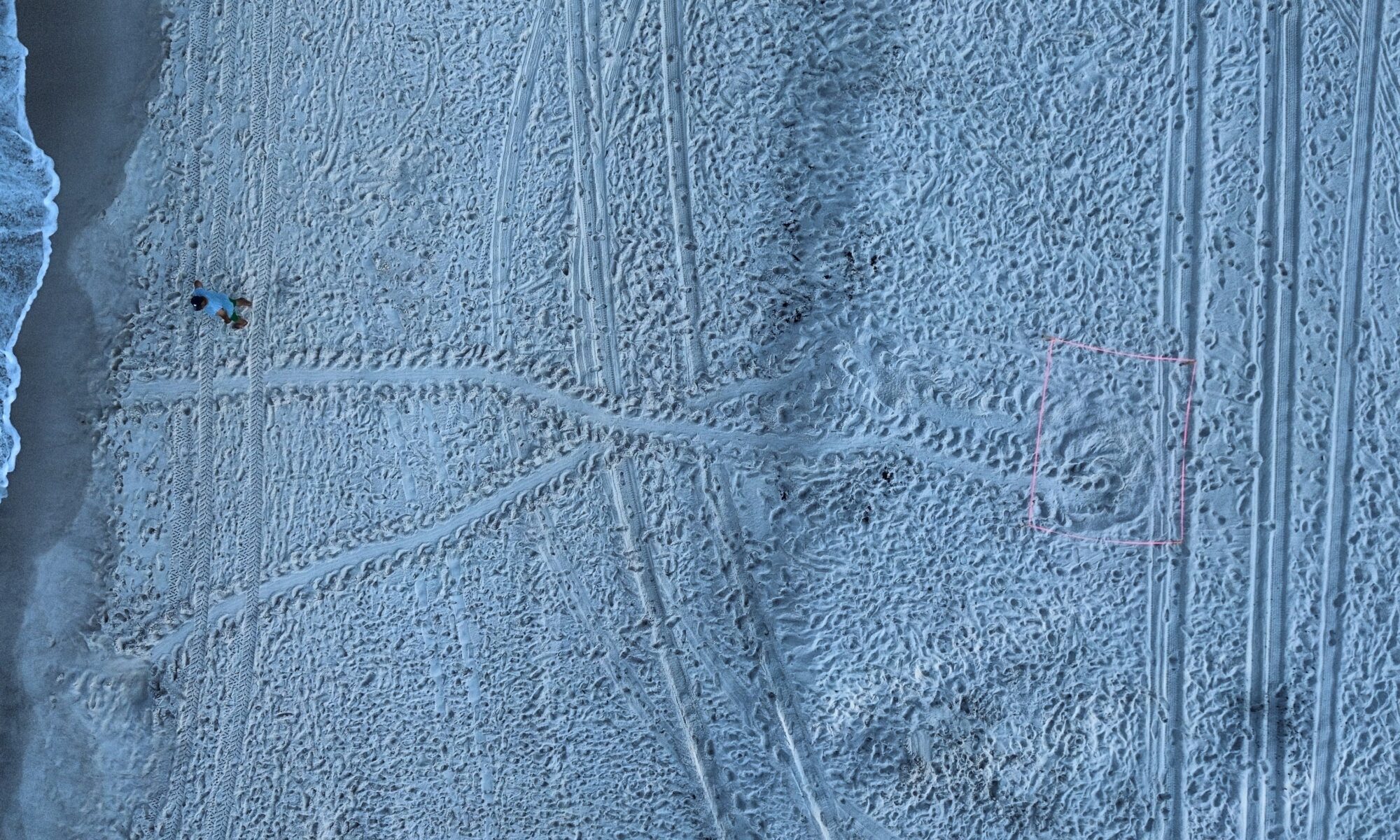
We now share with you the conclusion of the recent morning where our surveyor found multiple loggerhead sea turtle crawls.
You, the nesting loggerhead, have made two attempts to nest in the last several hours. You are determined to find a good spot on PCB to lay your nest. You swim another two plus miles once again deciding to give it another try. You emerge from the water, crawl about 40 feet and reach a sandy slope from a recent escarpment (vertical wall formed by wave action) in which you are able to scale with ease. You begin digging your body pit but the sand doesn’t feel quite right. You scoot forward another 20 feet and try again, finally everything feels right this time. You settle in and dig the chamber with your rear flippers, deposit ~100 eggs, cover the nest, make a turn and head back to the water. After a long night with two false crawls, you have traveled over 5 miles in the water and have now successfully nested.
Soon our PCB Turtle Watch morning surveyor will find your nest and is able to predict you are the same turtle that had the other two false crawls found this morning based on the crawl width, one of the data points we gather for each crawl we find. This particular female could have already nested on our beaches here in the panhandle prior to this nest and she may nest again as they can lay every two weeks resulting in between 3 and 7 nests in a season. Often when we observe a false crawl, we will find a corresponding nest crawl the same day or within the next day or two. If the sea turtle has made an attempt, there is a good chance she will keep trying until successful within a few days. The video explains the rest, this nest is now marked for protection and will remain on the beach until it hatches and is excavated to determine the hatch success.
Thanks for tuning into our multi-part story of one of our nesting loggerheads this season. We share this information with you in an effort to educate as many people as possible on sea turtle behaviors and how we can all help protect them.
If you encounter a sea turtle on our sandy beaches, please contact PCB non-emergency at 850-233-5000 and they will dispatch our volunteers. Please leave our beaches clean, dark and flat to provide the best nesting environment possible for these protected species!
Activities performed under MTP-038

Story time: A Loggerhead’s Journey to Nest part 2
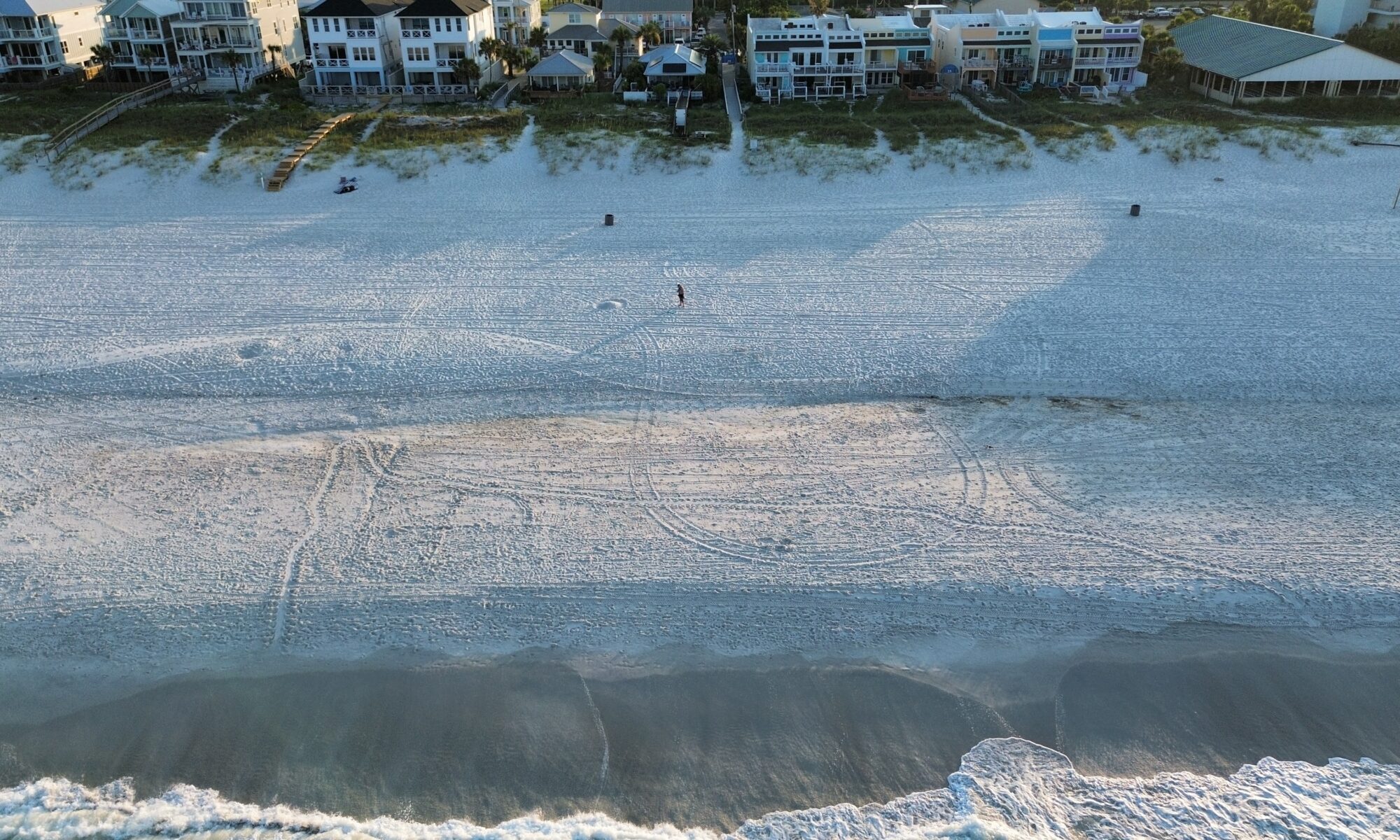
Thanks for tuning in as we continue on our mission as Panama City Beach Turtle Watch to protect sea turtles through our active volunteer program (full for this season) and through education efforts.
You’ll recall in our last post that our female loggerhead encountered bright lights and disturbance leading to a false crawl (non-nesting emergence). We now share the next chapter of her story.
Imagine you are the female loggerhead that very badly wants to nest. You are likely exhausted from your prior crawl where you attempted to nest but you instead escaped the paparazzi without nesting. You have returned to the water and begin to regain your strength and energy as you gracefully swim along. You have ~100 eggs that you are ready to lay but you need a good beach to lay them on. You swim, under the dark of night, about 3 miles from your first attempt. You pop your head up for a breath and see a darker empty beach, you are ready to give it another try. You swim toward the shoreline and emerge from the water. Once again crawling your ~300 pound self up the sandy beach about 60 feet and unfortunately something doesn’t feel right about this location. You wander a bit eastward, are you drawn to a bright light or the urban glow of Panama City? While your initial thought was this would make a good nesting site, you have now crawled over 130 feet from where you exited the water and haven’t nested, only to return to the water leaving another false crawl.
Above is the next crawl our surveyor found one recent morning. We have no beachgoer accounts of what happened at this location and based on the photos taken during our morning survey it doesn’t look like she was disturbed by beachgoers. But something wasn’t right, she wandered further than usual crawling over 130 feet parallel to the shore before returning to the water. On our Florida beaches, it is not uncommon to have false crawls as the turtles scope out the feel and appearance of the beach to choose their ideal nesting location. We assume this was a natural false crawl.
This particular loggerhead has now made two false crawls and is still very eager to nest. Where will she go next, stay tuned to find out!
If you encounter a sea turtle on our sandy beaches, please contact PCB non-emergency at 850-233-5000 and they will dispatch our volunteers. Please leave our beaches clean, dark and flat to provide the best nesting environment possible for these protected species!


Story time: A Loggerhead’s Journey to Nest
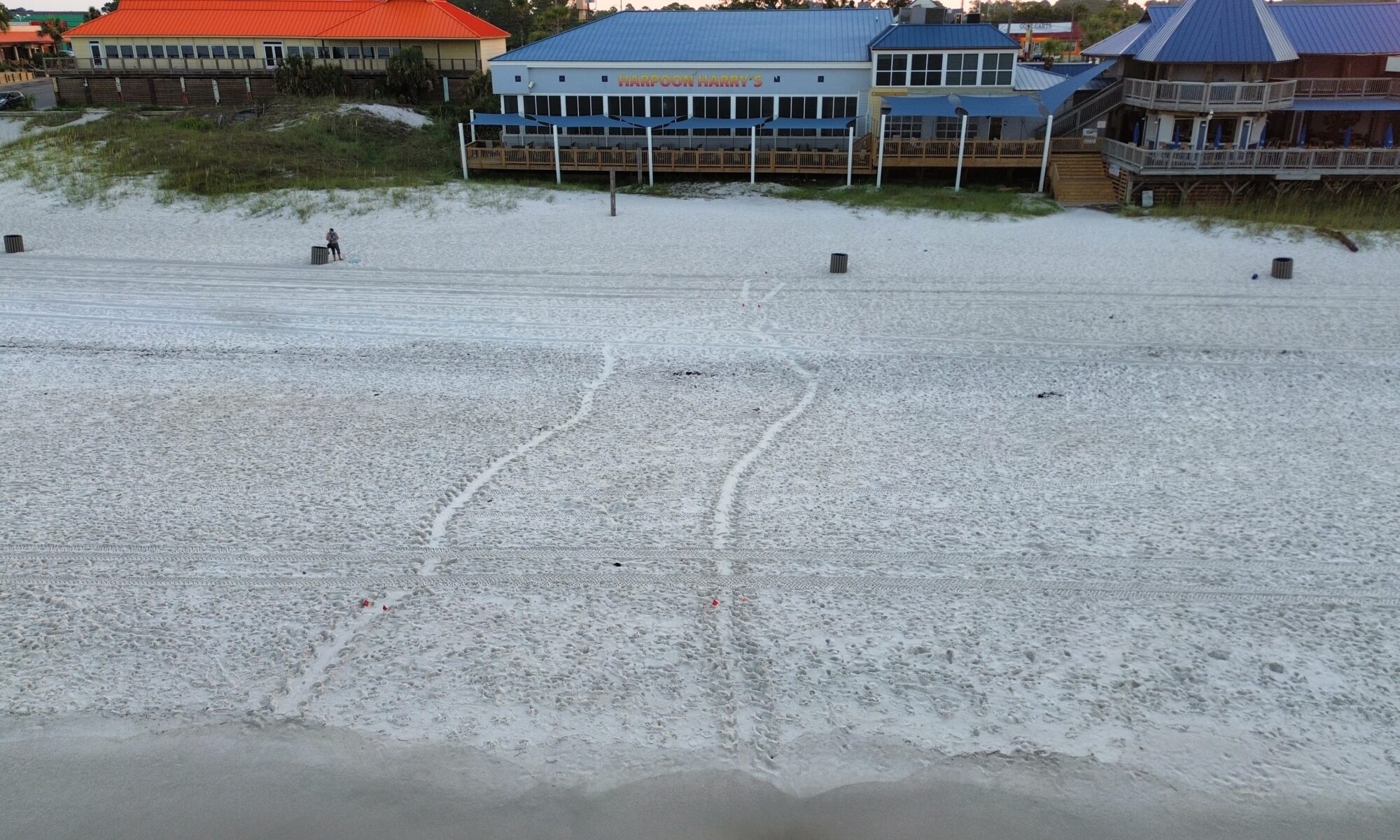
Join us for a multi-part story of a loggerhead’s attempt to nest on PCB to find out if she was successful.
Imagine you have been waiting all day knowing that tonight is the night to lay your eggs. The sun has set and the beach appears darker. You, the nesting loggerhead, choose a spot on PCB to exit the water, and crawl your ~300 pound self slowly about 80 feet onto the beach. You begin digging your body pit and you are swarmed by the paparazzi. Bright flashlights being shown on you, flash photos, a crowd getting a little too close for comfort and now you are temporarily blinded from all the bright lights. You abort your digging and try to get away (but still can’t see clearly because of the bright lights) crawling another 25 feet toward the dune before figuring out the correct direction of the water. The crowd is still very much nearby but you make a sharp turn and crawl over 100 foot back to the water to escape the paparazzi. You made a good attempt but this wasn’t the time or place to nest. Now it’s time to recover from that long exhausting and blinding crawl and decide where to next?


This is the scenario of a recent False Crawl shown in these photos. It is evident by the photos as well as other beachgoer reports that this nesting loggerhead was disturbed enough that she was not able to nest at this location which is what is called a False Crawl (a non-nesting emergence). Very near the trash can is where she finally turned and made her way back to the water. Her crawl at that point was very hard to see in person given all of the footprints all around.
How could her experience have been a better one? Beachgoers that encounter a nesting sea turtle (or hatchlings) should refrain from using any lights or flash photography. There is enough ambient light on our beaches that your eyes will adjust and you will be able to see what is happening without any additional light. Stay behind the turtle, out of her line of sight, remain quiet and just observe nature. As she moves, you should move too avoiding her crawl and staying behind her. When you encounter a sea turtle on our sandy beaches, please contact PCB non-emergency at 850-233-5000 and they will dispatch our volunteers. Please leave our beaches clean, dark and flat to provide the best nesting environment possible for these protected species!
Stay tuned in the coming days as we’ll share the next part of this nesting loggerhead’s journey.
Note: tire tracks near the water are from our morning surveyor that recorded data for this false crawl and then continued on with survey; other tire tracks are from law enforcement or vendors travelling the beach day and night and are the reasons that we respond asap to any report of a nesting turtle to get the area marked off for protection. In this case, no nest was laid.
All work performed under MTP-038